 |
 |
 |
||
| Part of the PAGenWeb Project | ||||
A | B | C | D | E | F | G | H | I | J | K | L | M | N | O | P | Q | R | S | T | U | V | W | X | Y | Z
Notable People of Warren County
Please submit your family histories (genealogies), stories concerning Warren County families, and other web pages about Warren County families and individual biographies.
ABBOTT, James A. - Sugar Grove twp (page i, Brief Personals *)
Was born in Sugar Grove in 1839, and married on March 1, 1865, to Lavantia C. Steward, in Harmony, Chautauqua county, N. Y., where she was born in 1845. They had a family of three children born to them — Sardius Steward, Archie Allen, and Florence Rhoda. James A. Abbott has been commissioner for two terms, and is a large stock and general farmer. He was a son of John G. and Agnes N. (Allen) Abbott. She was born in Colchester, N. Y., in 1806, and her husband was born in Rome, Oneida county, N. Y., in 1806, and they were married in Sugar Grove in 1829. They had a family of ten children born to them, eight of whom are now living — Albina C, Charles, Robert, James A., Noah W., Isabell, Loretta, and Jane. John G. Abbott died in 1873, Agnes N. Abbott died in Sugar Grove October 11, 1886. John was a son of Nathan and Johanna (Gibson) Abbott, who settled in Warren county, on the Brokenstraw, in 1814, coming there from Oneida county, N. Y. Agnes Nancy (Allen) Abbott was a daughter of John and Margaret (Holmes) Allen, who were born in Scotland and married there, and with one child immigrated and settled in Delaware county, N. Y., in 1801, and later went to Chenango county, N. Y., and in 1832 they came to Sugar Grove, where they settled. They had a family of nine children born to them, three of whom are now living — James, John, and Margaret. John Allen, sr., died in Sugar Grove in November, 1844; his wife also died at the same place.
ABBOTT, Noah W. - Sugar Grove twp (page i, Brief Personals *)
A practical contract sawyer and farmer, he was born in Sugar Grove in 1841. He was a son of John G. and Agnes Nancy (Allen) Abbott. Noah W. Abbott was married in 1864 to Mary M. Norris, of Freehold, who was born in 1845. They had a family of seven children born to them, six of whom are now living, one having died at an early age. Those living are John, Eugene, Earl, Christopher, Edward, and Harry. Mary M. was a daughter of Thomas and Ann Norris, who were early settlers in Freehold. They had a family of five children born to them—John, James, Elizabeth, Mary M., and Alice. John enlisted and it is supposed that he died while in the army.
[Warren County coordinator's note: In 1870, Noah and his family were living in Harmony township, Chautauqua County, N.Y. Noah was 28, a farmer whose real estate was valued at $850. Wife Mary, 24, had given birth to John, 5, Eugene, 3, and Earl, 1, in New York state. (Family #268) On the same census page are his parents John and Agnes Abbott, both 64, and daughter Jane E. Abbott, 18. John's real estate holdings were valued at $14,500, personal estate $3,500. (Family #266)
Noah Abbott died in 1910, wife Mary died in 1918; both were buried in the Cherry Hill Cemetery, Sugar Grove Township. Son Earl was born in 1869, died 1951, also buried with his wife (Mina E.) in the Cherry Hill Cemetery]
ACOCKS, Julia A. - Pittsfield (page ii, Brief Personals *)
Julia A. Acocks was born in Conewango, Warren county, in 1820. She was a daughter of Mark C. and Phebe (Greene) Dalrymple. Phebe was born in Rensselaer county, N. Y., and Mark C., her husband, was born in Vermont in 1799. They were married in Troy, N. Y., in 1810. Mark C. first settled in Pennsylvania in 1809, and in 1810 settled with his wife. She died September 17, 1841, leaving a family of six children, four of whom are now living — Julia A., Mrs. Lydia Foster, David R., and Mrs. Jerusha Ford. Mark Dalrymple was a prominent man of his county, and was the first sheriff of Warren county. He also held several other offices, and was always active in all town and county affairs. He died in April, 1873. Julia was married in 1835 to James L. Acocks. They had a family of three children born to them — Oliver Perry, Thomas L., and N. Lamar. James L. Acocks died in August, 1870. He was a prominent business man of the town, and was born in Hancock, Berkshire county, Mass., in 1814, and settled in Pittsfield in 1834; was married in 1835, and embarked in the hotel business in 1838. They were burned out, and in 1854 they erected the present hotel at Pittsfield, where Mrs. Acocks still resides with her son, N. Lamar, who is now engaged in the hotel business. He was married October 3, 1879, to Hattie Martin, of North Bay, Oneida county, N. Y. She died in 1883, leaving two sons-—James L. and Clarence S.
[Warren County coordinator's note: Julia A. (Dalrymple) Acocks died in 1901 and was buried with her husband in the Old Presbyterian Cemetery, in Pittsfield Township.]
ACOCKS, (Judge) William B. - Pittsfield (page i, Brief Personals *)
Judge William B. Acocks was born in Hancock, Berkshire county, Mass., in 1821. He was a son of William and Phebe (Baker) Acocks, who with a family of three children — Eliza Ann, James L., and William B. — settled in Ellicott, Chautauqua county, N. Y., in 1830. Phebe died in 1832, and William then married his second wife, Mrs. Caroline Kinsley, by whom he had three children, two of whom are now living— Grant A. and Mary Ann. William died in Illinois in 1867, and Judge William B. settled in Pittsfield in 1842, and embarked in the general blacksmith business, from which he retired in 1880. He served as justice of the peace for two terms, was side judge of the county for five years, from 1876 to 1881, and also held several other offices of the town. He was married in June, 1843, to Mary Ann Dalrymple, who was a daughter of Clark and Elizabeth (Shoff) Dalrymple. Elizabeth was born in Albany county, N. Y., and Clark, her husband, was born in Colerain, Franklin county, Mass., in 1796, and died in 1869. His wife died in 1883. They had a family of nine children born to them — David, Mark, William, Clark, Reuben, Oliver, Noah, Shelden, and Mary Ann. Clark Dalrymple settled in Warren county with his father, David Dalrymple, in 1811.
[Warren County coordinator's note: Judge Acocks died in 1914; his wife preceded him in death in 1888; both were buried in the Riverside Cemetery, Pittsfield Township.]
ACOMB, Dr. James Lafayette - Tidioute, Deerfield twp *
|
Born in Stanford Bridge, Yorkshire, England, February 27, 1828. He was a son of Joseph and Elizabeth Acomb who settled in Geneva, N. Y., in 1832. In the
spring of 1834 they moved to Sandy Hill, Steuben county, N. Y., and settled on a farm which he purchased and which is
still owned by them and known as the Acomb homestead. Joseph Acomb died in the
fall of 1834, of cholera, leaving an invalid wife and four children, two sons, and two
daughters — Thomas, James L., Margaret, and Elizabeth, the eldest of which was
Thomas, aged eight years. Elizabeth Acomb by her own industry and economy maintained
herself and four children until they were able to contribute to their own support.
She lived to see them all grown up, married and settled, and in good circumstances,
dying at the good old age of seventy-four years on April 7, 1875. Dr. James L. Acomb left home at the age of seven years,
and by his own efforts and close application to
business fitted himself for his medical profession, and graduated from the Syracuse
Medical College in 1853. He studied medicine in Buffalo, Erie county, N. Y., where
he began his medical practice, afterward moving to Cuba, Allegany county, N. Y., there
following his profession until 1865; then spending one year at Pit Hole, Venango
county, moving from there to Tidioute, Warren county, where he now resides and
enjoys a large and remunerative practice in his profession. On settlement here he
embarked in the drug and prescription business and still continues in the same, dealing
in all grades of fancy and staple goods of the drug trade. He has also been an oil
producer for the past fifteen years and is still in the same business. He was a volunteer
surgeon in the army in 1862, and has held some of the town offices in which he now
resides. He married Seraph Oliver, daughter of Squire Charles Oliver, of Rogersville,
Steuben county, N. Y., in 1863. By this union he had born unto him six children — four
sons and two daughters; the sons died in their early childhood; the daughters, Seraph
May and Lillian T., are still living and have received a collegiate education. Seraph
May married C. M. Knight, professor of chemistry and natural sciences, of Buchtel
College, Akron, O., where he now resides. Lillian T. graduated at Buchtel College,
Akron, O., in 1885, with appropriate honors.
[Warren County coordinator note: according to the 1870 census for Tidioute, Warren County, PA, Dr. Acomb, 42, owned real estate valued at $21,000 and his personal estate totaled $5,200. His wife, 5 years his senior, had a personal estate of $6,000. Their two daughters were 12 and 6 years old. According to his obituary, James died in Tidioute, on Thursday evening of June 6th, 1901; aged 73 years, 3 months and 10 days. He was buried in the Tidioute Cemetery. LINK to J.L. Acomb's obituary. Seraph died in 1908 and is buried with her husband.] |
AGRELIUS, John W. - Youngsville, Brokenstraw twp *
A general dry goods and grocery merchant, and proprietor of a drug and prescription and fancy goods store; he is also engaged in the manufacture of staves, heading and shingles, having a large steam-mill and factory in Youngsville. Mr. Agrelius was born in Sweden in 1838, and with his parents — Isaac and Inga Christina (Peterson) Agrelius— and their other five children, came to America and settled in Brokenstraw in 1851. Two more children were born after their arrival. Two sons of Isaac enlisted in the army during the civil war— Charles Gustavus in the 4th Pennsylvania Cavalry, and Andrew Peter in the 83d Pennsylvania Volunteers; both were captured and confined in Andersonville prison; were removed thence to Columbia, S. C , where they died. The six now living are Eva C, J. W., Clara T., Otto M., Eugene, Frank O. Isaac Agrelius was born in 1809, and his wife in 1810; the former is dead, and the latter is living in Kansas. John W. Agrelius is one of the energetic business men of the county. He embarked in the pump business in 1866, and in 1873 built a steam-mill, which was burned in 1876. Taking with him a partner — Judge Kinnear—he rebuilt the mill the same year. In 1878 he engaged in mercantile trade, and purchased the interest of his partner in the mill, which, together with his dry goods and drug stores, he conducts at present. He was appointed postmaster in January, 1884, and resigned December, 1885. He is agent for the American line of steamships of Philadelphia. Mr. A. [sic] married Sarah Jane Demmon, of Russellburg, in 1867; they have four children — Alice B., Grace G., Blanch B., and Ray V.
AKELEY family - Pine Grove twp (page iii, Brief Personals *)
Probably no family of the pioneers of Pine Grove has been as prolific as the Akeley family. They came to the town from Vermont about the year 1827. From the original pioneer of the family has sprung a race of over three hundred descendants. Jonathan was the eldest of the family born here, James F. was next; Ira, who died while an infant, and Rollin and Volney (twins), were the other children, natives of this town. Jonathan was a member of the 12th Pennsylvania Cavalry, and died while in service. James F. married Sarah Jane Widdifield, and had two children. After the death of his wife, Sarah Jane, Mr. Akeley married Mrs. Mary A. Andruss, of Corydon. James F. enlisted in Company G, 211th Pennsylvania Volunteers, and served until the close of the war. He still resides on the home farm which has been so long in the family. He is a member of the "Eben Ford" Post, G. A. R., a Republican in politics, and not. connected with any church society.
AKELEY, Joseph - Russellburg p. o., Pine Grove twp (page iii, Brief Personals *)
Joseph Akeley, one of the sons of the pioneer, Thomas Akeley, was born August 22, 1789. He married Eliza Ruland in 1829, who bore him eight children—Mary, Phebe, Cynthia, Huldah, Abigail, Harriet, William, and Thomas. These were the children of a second marriage. The first wife of Joseph Akeley was Cyntha Chase, and by her he had two children — Philena and Albert. William Akeley, child of the second marriage, now resides in Pine Grove, on a part of the original Akeley tract, his farm being one of the best in the town, and containing 117 acres. William Akeley married Theresa Jones, daughter of Joseph Jones, a pioneer, on March 23, 1867. They have two children — Carrie E. and Mattie T.. William Akeley was born December 14, 1838.
[Warren County coordinator's note: the 1860 U.S. Federal census for Pine Grove township, Warren county records the family as follows: Joseph Akeley, 70, farmer, value of real estate $1,500, value of personal estate $1,000, born Vermont; Eliza A. Akeley, 50, born New York; William Akeley, 21, farmer, born Penna; Thomas Akeley, 17, farmer, born Penna.]
AKINS, John A. - Youngsville p. o., Brokenstraw twp (pages iii-iv, Brief Personals *)
John A. Akins was born in Sweden in 1843, and was a son of John M. and Mary (Peterson) Akins, who were married in Sweden and with a family of five children immigrated to America and settled in Sugar Grove, Pennsylvania, in 1851. They now have a family of ten children, seven sons and three daughters. John M. was born in 1809, and his wife Mary in 1816. They were married in 1836, and two of their sons served in the War of the Rebellion. They were John A. and Jonas P.. Jonas P. has served one term in the Minnesota State Legislature. Jonas P. enlisted from Minnesota, and John A. first enlisted on nine months call in an independent company; was discharged and re-enlisted in 1863, Co. M 21st Pennsylvania Cavalry; was discharged after one year, re-enlisted in Co. K 12th Pennsylvania Cavalry in 1864, and served to the close of the war, when he was honorably discharged in August, 1865, at Philadelphia, Pa. John A. Akins was married in 1868 to Matilda C. Samuelson, who was born in Sweden and settled in Warren county, Pennsylvania, coming there with her parents in 1851. They have had a family of six children—John Frank, Edwin James, Bertha Belle, Clyde Raymond, Emma May and Ethel. He purchased his homestead of 150 acres in 1871, and has been commissioner of highways for the past seven years.
AKINS, Theodore, Chandler's Valley p. o., Sugar Grove twp (page iii, Brief Personals *)
Theodore Akins was born in Sugar Grove in 1859, and married Vesta Jones, of Ashtabula, O., in 1886. He has been town commissioner. His parents were John M. and Mary Oman Akins. They were born in Sweden, he in 1809 and she in 1816. They were married in Sweden, and came to Sugar Grove in 1851. They have had ten children — seven sons and three daughters— Christina, Matilda, Mary, Jonas P., John A., Andrew M., Charles F., O. William, Alfred D., and Theodore. Jonas P. and John A. enlisted during the civil war and served till it closed.
ALGER, Madison - Youngsville p. o., Brokenstraw twp (page iv, Brief Personals *)
Madison Alger is a general merchant. He was born in Chautauqua county, N. Y., in 1828; he settled with his parents in 1844 in Tidioute, where he remained till 1865, when he removed to Youngsville, his parents remaining in Tidioute till 1867, when they went to Jackson, Mich., where they died. Upon settling in Youngsville Mr. Alger embarked in mercantile, and lumber manufacturing and shipping business; he has built several saw-mills, and is now the oldest merchant in trade in the town. He married Ziltha Holladay, of Oil City, in 1850. They have three children — Elva, Ward, and Julia. Elva married A. H. Webb; Julia married Victory Pierce; and Ward married Kate Jordan. Mr. Alger first engaged in the lumber business on his own account at the age of nineteen years.
ALLEN, Abby P. - Brokenstraw (N. Y.) p. o., Freehold twp (page iv, Brief Personals *)
Abby P. Allen is a daughter of Elijah W. Allen, who was born in Otsego, N. Y., in 1804, and settled in Warren county in 1836, and died in 1865. He married Philena Brooks, of Otsego county, N. Y., who was born in 1808. They had a family of six children — Abigail, Vinton, Dewitt, Dwight, Horatio, and Melvin (deceased). Vinton Allen died October 23, 1886, of consumption. Horatio Allen, was hurt by a wagon tongue while running the wagon out of the barn on September 4, and died September 6, 1886. Mr. Allen was an extensive breeder of Durham cattle; his herd, established in 1845, was the first in the county. He came to this country in 1836, and at the time of his death he owned 1,000 acres in Pennsylvania and New York.
ALLEN, Dwight A. - Brokenstraw (N. Y.) p. o., Freehold twp (page iv, Brief Personals *)
Dwight A. Allen was born in Warren county in 1838. He married Louisa Woodin, of Warren county, and to them have been born three children — Ernest W., Lida J., and Herbert D. Mr. Allen is an extensive breeder of Devon cattle, and is well known throughout the country. He established his herd in 1874.
ALLEN, Orren C. - Russellburg, Pine Grove twp & the city of Warren (pages 683-685 *)
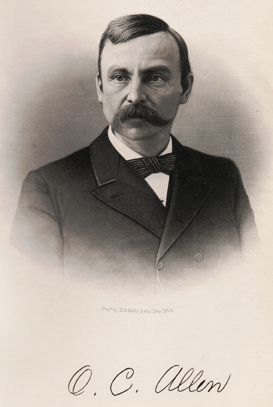 |
Orren C. Allen was born on a farm near Russellburg, Pine Grove township, Warren county, on the 1st day of May, 1840. He traces his ancestry back to his great-grandfather, who came from the north of Ireland about ninety years ago, and settled in the county of Dauphin, near Harrisburg, Pa. He died about sixty-seven years ago. He there owned and operated a saw and flouring-mill successfully, and lived to be about one hundred years of age. He was a man of strong character, though marked by decided eccentricities. Of his two sons, Thomas and James, the former was the grandfather of the subject of this sketch. The latter enlisted in the War of 1812 when he was quite young, and was never afterward heard from. Thomas grew up to partial manhood in Dauphin county, and went to western Virginia, near Georgetown, on the Ohio River, where he remained for fifteen or twenty years, and where he married Joanna Jones, a descendant from a Welsh family. About 1845 he settled in Pine Grove township, whither one of his sons had preceded him, and there died in 1855, aged sixty-six years. His wife survived him about ten years and died in the same town. They had eight children, three sons and five daughters, of whom the eldest, Samuel P. Allen, was the father of the subject of this notice. He was born in Virginia, and when quite a boy removed with his parents to what was called Sewickly Bottoms, in Beaver county, Pa. From there, about 1830, he emigrated to Russellburg, and engaged in lumbering. After a few years he married Mary, daughter of Caleb Thompson, one of the early settlers of Pine Grove township, and who was long a justice of the peace in Russellburg, and was noted for his enormous strength. He died at the age of eighty years. Samuel P. Allen and wife had a family of five sons and three daughters. |
The eldest son is Colonel Harrison Allen, who was born in 1834, admitted to the bar of Warren county in November, 1866, took an official part in the War of the Rebellion, served in the State Legislature in both houses, was made auditor general of Pennsylvania, afterward became United States marshal for Dakota territory, was superseded by a Democrat in 1885, and now resides in that territory. Samuel T, the second son, was admitted to the bar in February, 1864, served in the last war, held a clerkship in the office of the auditor general one term, was a clerk under General E. B. French in the treasury department at Washington, D. C, was three times elected burgess of Warren borough, and died on the 10th of January, 1885. The third child was the subject of this sketch. The next was Mary E., now the wife of Luther Bishop, of Warren. The fifth was George W. Allen, born at Pine Grove in March, 1845, was admitted to the bar of Warren county in December, 1866, served two honorable terms in the Legislature, residing until 1882 at Tidioute, and then removing to his present residence at Denver, Col. The sixth was Martha, now the wife of Fenton B. Hayward, of Russellburg. The next was Walter, who now resides in Warren, and the youngest is Ida, wife of Dr. H. H. Bowers, of Forrestville, N. Y.
O. C. Allen was reared on the farm on which he was born, remaining at home until he was twenty-one years of age. The farm was a pretty rough one, requiring hard work to manage it and gain a good livelihood from it, which they did. During his boyhood he attended the district schools in the winter time and worked on the farm every summer; the sons generally managing the farm while their father looked after the lumbering business. During the fall, as they approached manhood, the boys had the privilege of attending select schools in Russellburg for one or two months. Later still O. C. Allen went to the academy at Jamestown and at Randolph, N. Y., leaving the latter school in the spring of 1861. He remained on his father's farm until the harvesting was over in August of that year, when he came to Warren and began to study law in the office of Scofield & Brown. During two or three years before he was twenty-one years of age, and one winter after he began to study law, he taught winter schools to earn his own money. He reached Warren a comparative stranger, and with very little money. He rented a room in the Johnson Exchange building, purchased an outfit, and diminished his expenses by cooking his own provisions. This he continued for two years, at the same time pursuing his studies with the utmost diligence. The income from a little business which came to him then enabled him to live better, and he boarded at the Tanner House. In February, 1864, he was admitted to practice in the courts of Warren county, on the same day that witnessed the admission of his brother, S. T. Allen. His preceptors, Scofield & Brown, kindly gave him the use of their office for the first season free of rent, and he began to practice on his own account. Only one year later he was nominated and elected the disrict attorney for Warren county, and then opened his office in A. H. Ludlow's building. His success in practice was something unusual and was constantly on the increase; but after a few years Mr. Allen became connected with oil operations in Tidioute, in this county, and being somewhat broken in health, he concluded to abandon the practice of law for a time, and removed with his family to the village now called North Warren, though then less euphoniously denominated Berry's Corners. Several years in that place failing to bring him to a return of health, he removed to Richmond county, Va., purchased a farm, planted a large peach orchard, and remained a portion of the time for four years. He returned to North Warren about the time of the location there of the hospital for the insane. As soon as he discovered that the hospital was surely to be erected there, he and several other gentlemen purchased lands in the vicinity and laid them out into village lots. After disposing of these lots and of other land at a gratifying profit, he returned to Warren, and in company with his brother, S. T. Allen, and Dr. Laban Hazeltine, now of Jamestown, engaged in the drug business at the corner of Second and Liberty streets. At the end of a year he and his brother sold their interests, and the same season he was appointed postmaster of Warren, succeeding Captain Robert Dennison. He acted as postmaster eight years and was then followed by the present incumbent, Isaac Alden. On leaving the office he again engaged in the practice of law, in the office of his brother, and then formed the partnership with the district attorney, G. H. Higgins, which still continues.
In June, 1886, he was recommended by the county of Warren as a candidate for the State Senate in the Forty-eighth Senatorial District, composed of Warren and Venango counties, and was nominated at the district convention. The nomination was followed by a very spirited campaign, resulting in his election by a plurality of 1,830 votes, and in Warren county of a majority of 1,557 votes, or 500 more than were given to the State ticket at that time. This success is due to his personal popularity, the confidence which the members of his own party repose in him, and his plain and direct course as a politician, a strong member of the Republican party, but a courteous and just opponent. In business matters Mr. Allen has been uniformly successful, and no more significant praise can be bestowed than to say that amidst fierce competition, in spite of early poverty, by his own unaided efforts, without the use of dishonest expedients, he has become a man of means. He has always been extensively interested in building operations, and a few years ago erected the block which he now occupies.
On the 12th of July, 1864, he married Maria C., daughter of W. M. Cook, of Russellburg, his present wife. They have two sons, W. H., born July 21, 1867, and Samuel G., born August 24, 1870. They are both boys of great promise, and are afforded all the advandages of a thorough education, and are now attending the military and naval academy at Oxford, Md.
ALLEN, Samuel P. - Russell p. o., Pine Grove twp (page iv, Brief Personals *)
Samuel P. Allen was born in Virginia on January 7, 1810, and while yet young his father's family moved to Beaver county, where they continued to reside until 1832, when Samuel came to Pine Grove. His father, Thomas Allen, and several of the others of the family came several years later. Thomas Allen died in Pine Grove, after a residence of about ten years. Samuel, who was the oldest of eight children, married first Mary E., daughter of Caleb Thomson, on March 17, 1833. The children of this union were Harrison (who was U. S. Marshal of Dakota), Harriet, Samuel, Orrin C., George W., Harriet second (born after the death of the first child of that name), Mary Martha, Walter, Ida, and one child that died unnamed. Samuel P. Allen followed the Ohio River, rafting lumber for over forty years, but of late years has turned his attention to farming, at which he has been very successful, having a fine farm of 247 acres of land. He has been a prominent figure in town politics, frequently holding town offices. Before the late war he was a staunch Democrat, but since that time has voted with the Republican party. He is an active member of the M. E. Church. Thomas Allen, his father, was a soldier in the War of 1812.
ALLEN, Zurial - Lander p. o., Farmington twp (page iv, Brief Personals *)
Zurial Allen is a farmer and was born in Royalton, N. Y., June 3, 1822. He was a son of Jacob and Olive (Tupper) Allen; settled in what is now Farmington, in 1830, locating on Thompson Hill, clearing and improving a farm on which they lived and died. They had a family of four children, who grew to maturity— Harriet, Lydia E., Cynthia (deceased), and Zurial. Zurial Allen was reared on the old homestead from eight years of age, and resided on the same up to 1863, when he removed to Farmington Center, where he has since resided. He was married in 1845 to Elizabeth Cramer, a daughter of Abram and Mary (Stewart) Cramer, of Farmington. They have one adopted child, Myrtle B.. Mr. Allen and his wife are members of the Baptist Church. In politics Mr. Allen is a Republican.
AMANN, George - Warren p. o., Pleasant twp (pages iv-v, Brief Personals *)
George Amann, an Alsacian, with his wife Katherine (Jssler) Amann, and their children, came to Pleasant township during the summer of 1840. Their children were George, Martin, Jacob, John, Mathis, and Mary (who was a native of this country). The father, George, died on August 14, 1867, and his wife Katherine died in July, 1870. Jacob Amann married Marguerette Schweng, of Warren, who bore him eight children — Lena M., Henry E., Jacob M., Mary J., Michael, Anna C., Clara W., and Celesta G.. Of these children Lena M. and Celesta are the only ones now living, and the sad visitation of the death of six of their children has been a most severe one to the loving parents, whose hearts have been continually bowed under its weight. Jacob Amann took up his residence in Glade in 1856, and notwithstanding his afflictions he is an active and prominent farmer, having 106 acres of land well located in the north part of the town.
AMANN, John - North Warren p. o., Conewango twp (page v, Brief Personals *)
John Amann was born in Sundhausen, Alsace, France, December 1, 1836. He is the son of George and Catherine (Elser) Amann, who settled in Pleasant township in 1840, clearing part of a farm there, where the father died in August, 1857. George Amann had six children — George, Martin, Jacob, John, Mathias, and Mary (Mrs. John Dible). John Amann was reared in Pleasant township from four years of age. In 1858 he located in Conewango, and in 1881 he purchased the farm where he has since resided. On July 10, 1860, he married Christiana C., daughter of Henry and Christiana (Baker) Weis, natives of Wiirtemburg, Germany, who settled in Chautauqua county, N. Y., in 1854. By this union there are three children— Rosanna (Mrs. David Uhl), George, and Lorena. Mr. Amann and wife are members of the Lutheran Church.
ANDERSON, Augustus - Pittsfield, Pittsfield twp (page v, Brief Personals *)
Augustus Anderson was born in Sweden in 1841. He was a son of John Nelson and was adopted by his uncle Charles Anderson, and with him came to America and settled in Chautauqua county, N. Y., in 1852, and in 1854 he settled in Freehold township, where his uncle died in 1862. After the death of his uncle, Augustus became engaged in farming, and in 1866 he settled in Pittsfield, and there embarked in the general smithing business. He hired a foreman and soon learned the trade, and in 1879 he erected his present fine shop, with a public hall in the second story. He stocked his shop with all of the latest improved tools and machinery that could be found, for his extensive trade He was married in February, 1869, to Christina Johnson of Freehold. They have had one daughter born to them, Ina L.. Mr. Anderson held the office of collector in 1875 and 1876, and was constable in 1875. He is now engaged largely in farming.
ANDERSON, Peter A. - North Warren p. o., Conewango twp (page v, Brief Personals *)
Peter A. Anderson was born in Sweden on December 7, 1850. He is a farmer and was a son of Andrew and Louisa (Erickson) Anderson. He came to America in 1872 and settled in Warren county, and in 1881 he came to Conewango and settled on the farm on which he now resides, which he has cleared and improved himself. His father came to this country in 1876, and died in 1885. He had five children who came to America — Peter A., Oscar, Andrew, John, Otto, and Josephine. Peter A. Anderson was married in 1876 to Eva Lawson, of Sweden. They have had four children — Amelia, Albert, Selma, and Frank. Eva was a daughter of Augustus and Mary Lawson, who were natives of Sweden.
ANDREWS, Hiram F. - Garland p. o., Pittsfield twp (pages v-vi, Brief Personals *)
Hiram F. Andrews, one of the leading business men of Warren county, was born in Pittsfield in 1838. He was married in 1862 to Sarah A. Thompson, who died in 1882 leaving a family of six children — Delia, Earl, Khlare, Maud, Leah, and Floyd. In April, 1883, he was again married to Mary Davies, who was born in Wales. In early life Hiram F. Andrews was a farmer; in 1859 he was appointed the first postmaster of Garland. He has been and is now connected with all the leading branches of business in the town. He embarked, in 1866, in the general merchandise business under the firm name of W. B. Street & Co.; his uncle, Moses Andrews & Co., took the business in 1870. He built his first steam saw-mill in 1871 and then formed the firm of Hiram Horn & Andrews; this firm continued until the death of Mr. Horn, which occurred in 1880, when Mr. Andrews went out of the business and became engaged in two separate branches of trade, that of hardware dealers doing business under the firm name of Watt & Andrews, and also that of Andrews & Co. (D. J. McMillen), who were engaged in the general dry goods and grocery trade. Mr. Andrews is also connected with the firms of Moore & Andrews and Hill & Andrews, engaged in the manufacture of lumber and shingles; also engaged in farming and fruit growing. Hiram F. Andrews was a son of Robert Andrews, jr., and Jane Manderville. Jane was born in Claverack, N. Y., and her husband Robert was born in Pittsfield. They had a family of four children born to them. Robert was drowned in the Brokenstraw River in 1850. He was born in 1801. He was a son of Robert, sr., and Anna (Ross) Andrews, who settled in this town in 1795. They had a family of nine children born to them, only one of whom is now living — Moses Andrews, who was born in 1803; is a bachelor and now resides with Hiram F.. Robert was a soldier in the Revolutionary War. He built the first mill on the Brokenstraw River. The children of Robert and Jane were Hiram F., Alcinas, Eliphalet, and Eda.
ARNOLD, John - Warren p. o., Conewango twp (page vi, Brief Personals *)
John Arnold was born in Alsace, France, on June 24, 1821, and was a son of Christian and Katherine M. (Mathis) Arnold, who came to this country in 1841 and settled in Brokenstraw, where they lived for about fifteen years, after which they settled in Warren, where they resided until the time of their deaths. They had a family of three children — John, Christian and Mathis. John Arnold settled in Conewango in 1858, on the farm now occupied by him, most of which he has cleared and improved himself. He was married in 1846 to Mary S. Weiler, who died February 16, 1886; she was a daughter of George and Barbara (Rockenbach) Weiler, who settled in this county in 1832. John Arnold has had a family of four children born to him — Charles H., Albert W., John B. (married to Josie L. Somers, of Warren, June 30, 1883; resides at Warren), and Sarah S. (Mrs. George J. Gross).
ARTHUR, Robert (page vi, Brief Personals *)
The family of Robert Arthur came to Warren county in the year 1798, coming down the Allegheny River in canoes, and driving their stock through the paths and trails along the banks of the stream. Beside Mr. Arthur, the pioneer, there came with him his wife, and John, William, Robert, jr., James, Boone, Samuel, Charles, Betsey, Manley, and Rebecca, their children, none of whom are now living. Robert Arthur, jr., married Mary Wilson, by whom he had a family of ten children, all of whom grew to be men and women. They were William, Isabelle, Susan, Robert, Isaac, Mary, Margurette, Brison, Alexander, and Caroline. The first settlement of the family was made at Warren. Robert, the pioneer, subsequently lived and died at Brokenstraw. Robert, jr., died in 1865 in the town of Corydon, where he located in 1853. Brison and Alexander Arthur still reside in the south part of Corydon, and are among the substantial farmers of the town. Having passed the middle age of life, they are content to live out their allotted time on their farms adjoining, near the banks of the Allegheny, whose waters furnished means of conveyance to the county for their pioneer ancestors.
[Warren county coordinator's note: On the 1850 U.S. Federal census for Pleasant township:
On the 1860 U.S. Federal census for Corydon township:
On the 1870 U.S. Federal census for Corydon township:
End coordinator note]
AXTELL, Doctor A. C. - Youngsville p. o., Brokenstraw twp (page vi, Brief Personals *)
Doctor A. C. Axtell, present physician and surgeon of Youngsville, was born in Sheakleyville, Mercer county, on July 14, 1828. He was a son of Doctor Samuel and Mary (Loveridge) Axtell, natives of Washington county, who died in Mercer county, he at the age of seventy-four years, and she died in 1884 at the advanced age of ninety-five years. She left a family of nine children—three sons physicians—Doctors W. H., M. B., and A. C; two sons who are farmers — L. S. and J. M., and one son a clergyman, N. H., D. D., and also three daughters. Dr. A. C. Axtell read medicine with his father, and attended lectures at Columbus, O., in 1853 and '54, and settled in New Lebanon in 1854, in the practice of his profession, and in 1865 he settled in Youngsville, where he enjoys an extensive practice in medicine and surgery. He was married in 1853 to Fanny White, of Sheakleyville. They have had a family of five children born to them — Mary, Emma, Willie (died December 30, 1881; one of the most successful teachers in Warren county), Hattie, and Charles S. Hattie is now a teacher in the high school; Mary married Oscar Shutt, and Emma married C. D. Arird, who is the present county superintendent of schools. Doctor Axtell was a volunteer surgeon in the government hospitals at the time of the War of the Rebellion.
AYER, H. S. - Columbus twp (pages vi-vii, Brief Personals *)
H. S. Ayer was born in Eaton, Madison county, N. Y., in 1828, and was a son of Samuel H. and Roxana (Damon) Ayer. Roxana was born in Massachusetts in 1801, and Samuel H. was born in Pomfret, Conn., the same year. They were married in the town of Eaton, N. Y., in 1825, and settled in Columbus borough in 1834, where Samuel erected a carding and cloth-dressing mill where the tannery now stands. Roxana was a daughter of Thomas and Lovina Damon, who were born and married in Massachusetts and settled in Columbus in 1837, coming here from Madison county, N. Y., with a family of six children, two of whom are now living — James and Roxana. H. S. Ayer was married in 1875 to Ellen Cady. They have had a family of three children born to them — Ruth E., Martha R., and Anna L. Ellen was a daughter of George and Eliza (Horn) Cady. H. S. Ayer became a general merchant at Clymer, Chautauqua county, N. Y., in 1860, and erected a custom and merchant flour-mill, and was also engaged in the manufacture and shipment of lumber. He retired from the mercantile business in 1872, but continued in his lumber interest until 1879, when he became one of the founders of the popular organization in the State, the E. A. U. Mr. Ayer was supervisor of Clymer in 1863 and '64, also in 1867 and '68. He settled in Columbus in 1879, and has been justice of the peace for two terms. He is now the general accountant for the E. A. U.
* Source: History Of Warren County Pennsylvania with Illustrations and Biographical Sketches of Some of Its Prominent Men and Pioneers, edited by J.S. Schenck, assisted by W.S. Rann; Syracuse, N.Y.; D Mason & Co., Publishers; 1887.
Return to Warren County Genealogy homepage | Township Index
A proud participant in the USGenWeb and PAGenWeb Projects
© 2010 - 2021 Penelope Repko and contributors
© 2008 - 2009 Bill Klauk and contributors